
.png?crc=4271212285)

Electrolytic cleaning tests on a fragment of plate 3 of Vinkovci hoard, Croatia
June 11-13, 2024
___________________________________________________________
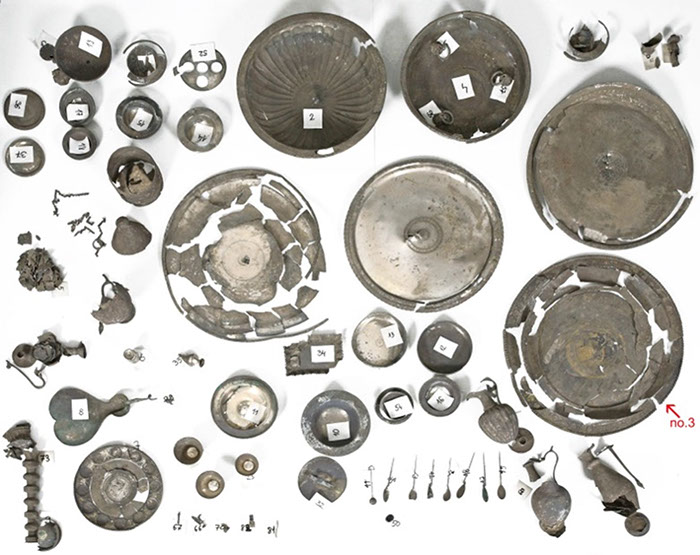
During the ENDLESS-Metal workshop organised at the Hungarian National Museum in Budapest (15-16 May 2023), we had the opportunity to carry out some electrolytic cleaning tests with Pleco® of corrosion layers consisting mainly of silver chloride (AgCl) on a fragment of a silver alloy dish from the Vinkovci Treasure made available by Damir Doračić, senior conservator at Zagreb Archaeological Museum. As a reminder, these layers are usually removed mechanically or chemically. The other techniques tested (laser abrasion and plasma) were not satisfactory. The results were interesting, despite the thickness of the corrosion layers, on the back of the fragment where the thickness is thinnest and on the face of the object where the metal is partially gilded. Due to lack of time, the tests had to be interrupted.
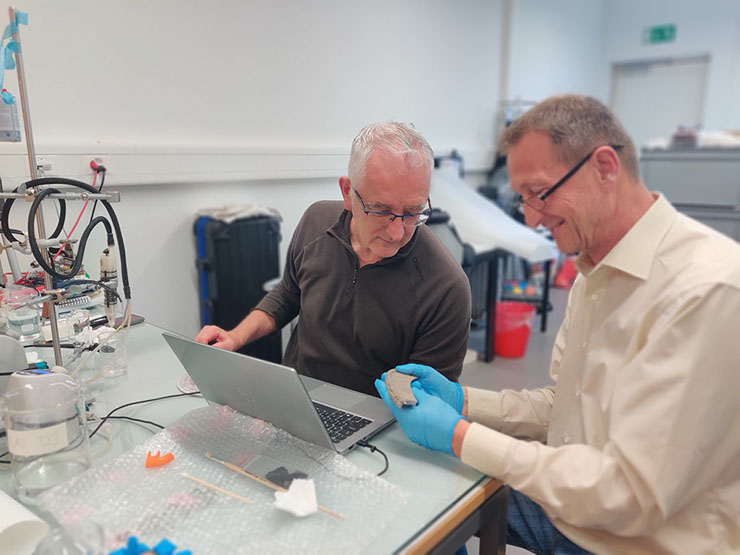
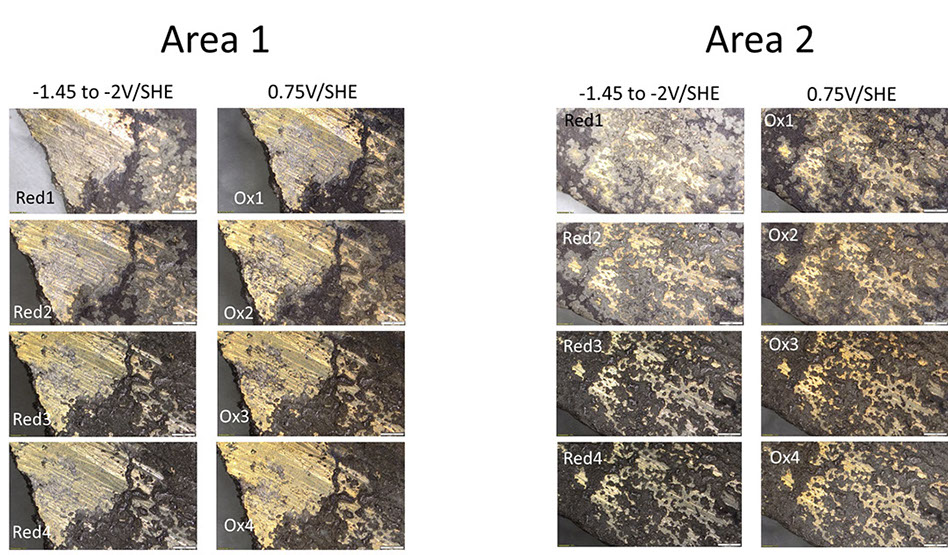
Damir Doračić wanted to repeat the tests on a 2nd fragment of this dish. This time the tests were carried out on the premises of Haute Ecole Arc Conservation-restauration, in Neuchâtel, Switzerland. Zones 1 and 2 were mechanically cleaned beforehand and the Pleco® tests were carried out after surface degreasing. The parameters were established by linear cathodic voltammetry on the back surface where the corrosion layer is thinnest. Reduction of AgCl was possible at -0.45V/SHE and redissolution of pre-reduced Ag at 0.75V/SHE. To clean the layers on the front, we had to decrease the reduction potential to -1.45V, or even -2V/SHE. Oxidation to dissolve the pre-reduced silver was always carried out at 0.75V/SHE. It should be noted that the AgCl layer reduces progressively and is eventually eliminated, but the treatment is laborious.
Given the number of objects in the Vinkovci treasure, Pleco® cannot compete with the other traditional cleaning methods used to date. The tool can, however, be used in the final phase of treatment when tarnishing residues have not been removed mechanically and the gold layer, still partially tarnished, needs to be restored to its original appearance.
COST (European Cooperation in Science and Technology) is a funding agency for research and innovation networks. Our Actions help connect research initiatives across Europe and enable scientists to grow their ideas by sharing them with their peers. This boosts their research, career and innovation.
COST - Endless Metal © 2023 All Rights Reserved

Funded by
the European Union